
Polymorphism in java is one of the important concept which allows objects to behave differently based on their specific class type . In Java , polymorphism allows the same object or method to behave differently based on the context of the project.
Features of Polymorphism:
- Runtime Decision : Java determines which method to call depending on the objects actual class at Runtime .
- Multiple Behaviors: In Java Polymorphism , the same method can behave differently depending on the object .
- Method Overriding : A subclass/childclass can redefine a method of its superclass/parentclass by overriding the method of its parent class .
- Method Overloading : In Java, we can define multiple methods with same name but with different parameters which is called method overloading.
Why to use Polymorphism In Java?
Polymophism in Java has many advantages which are listed below :
- Code Reusability : Polymorphism allows the same class or method to use with different types of objects , which makes the code more reusable .
- Dynamic Behavior : In Java , with polymorphism , Java can select the appropriate method to call at runtime , which gives the program dynamic behavior based on the actual object type rather than the reference type , due to which the flexibility of the program increases .
- Flexibility : Java Polymorphism enables the object of the classes to be treated as objects of a common superclass , which provides flexibility in method execution and object interaction .
- Abstraction : Java Polymorphism allows the use of abstract classes or interfaces , enabling us to work with superclass or interface which simplifies the interaction with objects .
TYPES OF JAVA POLYMORPHISM :
In Java , polymorphism is mainly divided into two types .
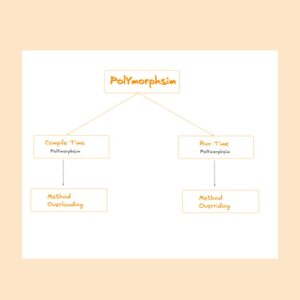
- Compile-Time Polymorphism : Method Overloading in Java is known as Compile-Time polymorphism. Compile-Time Polymorphism is also known as static binding or early binding. Method overloading happens when multiple methods in the same class have the same name but with different parameters .
Method Overloading :
Method overloading in Java means when there are multiple methods with same name but with different parameters . The number of arguments can be different in different method or types of arguments can be different in method overloading . But only change in return types cannot make the method overload as ambiguity problem may occur .
Example :
class Addition
{
int add ( int a , int b )
{
int sum= a+b;
return sum ;
}
int add ( int a , int b , int c )
{
int sum = a+b+c;
return sum;
}
}
class MethodoverloadingExample
{
public static void main (String args [] ) {
Addition aobj=new Addition () ;
System.out.println(aobj.add(34,28));
System.out.println(aobj.add(29,35,1));
}
}
OUTPUT :
62
65
2. Runtime Polymorphism:
Runtime polymorphism in Java is also known as Dynamic Method Dispatch or Late Binding . Java Runtime polymorphism is a process in which a function call to the overriden method is resolved at Runtime . This Runtime polymorphism is achieved through Method overriding .
Method Overriding
In Java, Method Overriding means when a subclass method provides a specific implementation of a method which is already present in its superclass. The overriding method in the subclass must have the same name , return type , and parameters as that of the superclass . Method overriding in Java allows a subclass to extend or modify the behavior of an existing method of the super class . Method overriding enables dynamic method dispatch , where the method that gets executed is determined at runtime .
Example:
// Parent class
class Gift {
//Method in the parent class
public void gift ( ) {
System.out.println(“Gift is awesome “);
}
}
//Child class that inherits from superclass Gift
class StudentGift extends Gift
{
@Override
public void gift() {
System.out.println(“Student Gift is an incredible book”);
}
}
//Child class that inherits from superclass
class TeacherGift extends Gift
{
@Override
public void gift () {
System.out.println(“Teachers gift is $11000”);
}
}
//Main class
public class MethodoverridingDemo{
public static void main (String args [] ) {
// create a Gift object
Gift gif = new Gift () ;
gif. gift(); //calls the Gift class method
//create a TeacherGift object
TeacherGift tgif =new TeacgerGift();
tgif.gift(); // calls the overriden method of TeacherGift class
//Achieve Dynamic Dispatch or Runtime polymorphism
Gift dgif= new StudentGift();
dgif.gift(); // calls the overriden method in StudentGift class
OUTPUT:
Gift is awesome
Teachers gift is $11000
Student gift is an incredible book
Method Overloading vs Method Overriding
The difference between Method Overloading and Method Overriding in Java are as follows:
| Feature | Method Overloading | Method Overriding |
|---|---|---|
| Definition | Method overloading describes defining multiple methods with the same name but different parameters in the same class | Method Overriding means implementing a parent class method in the subclass with the same signature and compatible return type. |
| Purpose | Method Overloading in Java is used to achieve compile-time polymorphism which is also known as static binding. | Method overriding in java is used to achieve runtime polymorphism which is also known as dynamic binding. |
| Parameter List | In Method Overloading the parameter list must be different (in number , type or order ) | In Method Overriding, the parameter must be exactly the same as in the parent class. |
| Inheritence | In Java method overloading , inheritance is not required as overloading occurs within the same class. | Java method overriding requires inheritance between super class and sub class. |
| Return type | Return type of java method can be same or different | The return data type of overriding method must be same or covariant type(sub type of superclass method’s return type ) |
| Access Modifier | Java method overloading can have any access modifier | Java method overriding cannot reduce parent method’s access level. |
| Static/Final Methods | Java static/final methods can be overloaded | Java static/final methods cannot be overriden. |
| Exception Handling | Java overloaded method can declare any exceptions | Java overriden method cannot throw broader checked exceptrions than the super class. |
| Binding Time | Method overloading indicates Compile-time binding | Method overriding indicates Run-time binding. |